
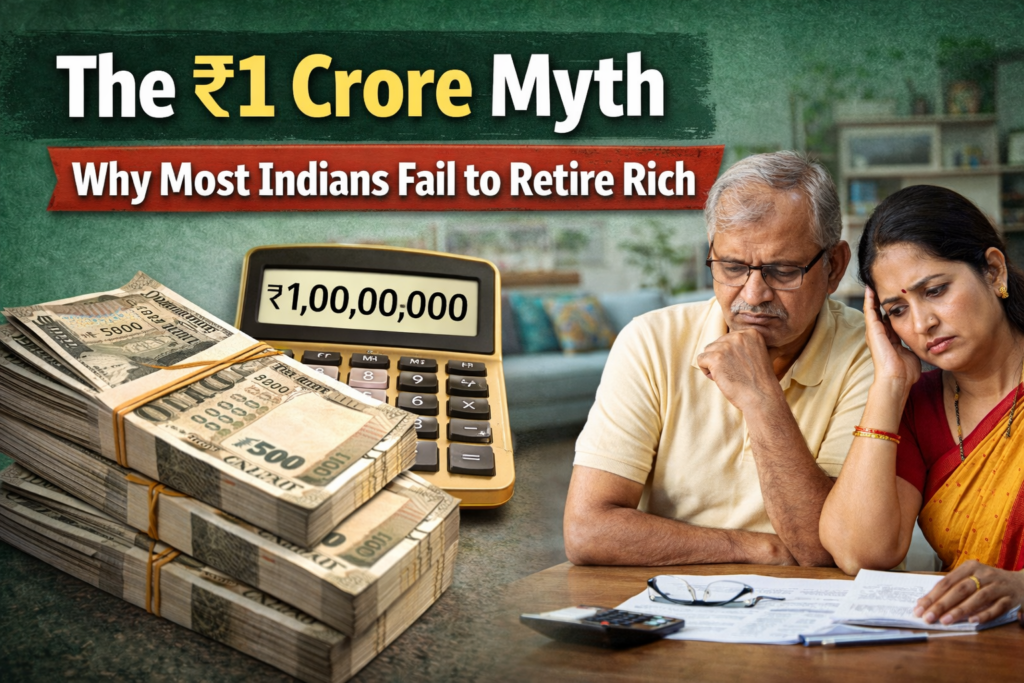

The ₹1 Crore Myth: Why Most Indians Fail to Retire Rich
₹1 Crore Retirement Myth: For many middle-class Indians, ₹1 crore has long been seen as the ultimate retirement goal. It’s a round number, psychologically satisfying, and often repeated in financial conversations: “Bas 1 crore ho jaye, phir retirement tension-free.”
But is that really true in today’s economic reality?
With rising inflation, increasing healthcare costs, and longer life expectancy, the belief that ₹1 crore is enough for a comfortable retirement may no longer hold. Let’s explore why this retirement milestone could be misleading and what you should actually focus on.
The Emotional Power of ₹1 Crore
In the 1990s and early 2000s, ₹1 crore was considered an enormous sum. At that time:
-
Property prices were lower
-
Medical costs were manageable
-
Education expenses were reasonable
-
Lifestyle expectations were simpler
However, India’s economy has grown rapidly. Urbanization, lifestyle changes, and global exposure have significantly increased living costs.
Today, ₹1 crore is still a big achievement—but whether it is enough for retirement depends on multiple factors.
Inflation: The Silent Retirement Destroyer
Inflation is the biggest reason why ₹1 crore may not be sufficient.
If your monthly expense today is ₹50,000 and inflation averages 6% annually, in 25 years those same expenses could exceed ₹2 lakh per month.
Most people calculate retirement needs based on current expenses, ignoring future cost increases. That is a critical mistake.
A retirement plan must always consider future value, not present value.
Longer Life Expectancy Means More Expenses
Earlier generations often lived up to 65–70 years. Today, many Indians live beyond 80.
If you retire at 60 and live until 85, you need funds for 25 years without earning active income.
Let’s assume future retirement expenses are ₹1 lakh per month.
That equals ₹12 lakh per year.
Over 25 years, that totals ₹3 crore (without even adjusting for rising costs).
Suddenly, ₹1 crore appears insufficient.
Healthcare Costs Are Rising Rapidly
Healthcare inflation in India is higher than general inflation.
Major medical procedures can cost anywhere between ₹5 lakh and ₹20 lakh or more. Long-term treatments and medicines add further expenses.
Without:
-
Adequate health insurance
-
A medical emergency fund
-
Proper financial planning
Retirement savings can reduce quickly after one serious medical event.
The Fixed Deposit Trap
Many retirees prefer keeping their entire corpus in fixed deposits for safety.
If ₹1 crore is invested at 6% annual return:
It generates ₹6 lakh per year before tax.
After tax, the income may be around ₹5 lakh annually.
That equals roughly ₹40,000–₹45,000 per month.
In urban India, that amount may barely cover basic expenses — especially after 10–15 years of inflation.
Safety is important, but growth is equally necessary in retirement planning.
₹1 Crore Retirement Myth: Changing Retirement Aspirations
Modern retirees want more than just survival. They want:
-
Travel and leisure
-
Comfortable living standards
-
Financial independence
-
Ability to support children if required
-
Freedom from financial stress
These expectations require strategic wealth creation, not just reaching a round-number milestone.
Why Most Indians Fail to Retire Rich
Here are some common mistakes:
1. Starting Too Late
Many individuals begin serious investing after age 35 or 40. Compounding works best when started early.
2. Lack of Equity Exposure
Avoiding equity completely limits long-term growth. Historically, equity investments have outperformed inflation over long periods.
3. No Clear Retirement Target
Saving without a calculated goal leads to under-preparation.
4. Lifestyle Inflation
As income increases, spending often increases faster.
5. Ignoring Inflation in Calculations
This is the most common and dangerous error.
What Should Be the Ideal Retirement Corpus?
There is no universal answer. It depends on:
-
Your lifestyle
-
City of residence
-
Monthly expenses
-
Retirement age
-
Investment returns
-
Risk tolerance
However, many financial planners suggest that urban middle-class families today may require ₹2–4 crore for comfortable retirement, depending on circumstances.
The key is personalized financial planning.
How to Build a Strong Retirement Plan
Instead of chasing ₹1 crore, focus on building a structured strategy:
Start Early
If you invest ₹10,000 per month at 12% average return starting at age 25, you could accumulate several crores by 60.
Increase SIP Annually
Increase your investment by 5–10% every year as income grows.
Diversify Assets
A balanced portfolio may include:
-
Equity mutual funds
-
Index funds
-
NPS
-
EPF/PPF
-
Debt instruments
Maintain Emergency Fund
Keep at least 6–12 months of expenses separately.
Buy Health Insurance
Do not rely solely on employer-provided coverage.
Review Annually
Financial planning should evolve with changing life stages.
The Bigger Picture: It’s Not About ₹1 Crore
The real issue is not the number itself.
The issue is believing that one fixed number guarantees financial freedom for everyone.
Retirement planning is not about hitting a milestone. It’s about creating a system that generates stable income, protects against risks, and adjusts for inflation.
Financial independence requires the following:
-
Discipline
-
Long-term consistency
-
Smart asset allocation
-
Continuous review
₹1 Crore Retirement Myth: Final Thoughts
₹1 crore remains a significant financial milestone. But in today’s economic environment, it may not automatically ensure a stress-free retirement.
Instead of asking, “Is ₹1 crore enough?”
Ask:
-
What will my future expenses be?
-
How long will I need income after retirement?
-
Is my investment strategy beating inflation?
-
Do I have adequate medical protection?
Retirement success depends on planning, not just saving.
The ₹1 crore myth teaches us one important lesson:
Financial security is built through strategy, not round numbers.
Inflation Data – Reserve Bank of India (RBI)
Anchor Text: “Reserve Bank of India inflation data”
🔗 https://www.rbi.org.in
Use in: Inflation section
Life Expectancy – World Bank (India)
Anchor Text: “World Bank life expectancy data for India”
🔗 https://data.worldbank.org/indicator/SP.DYN.LE00.IN?locations=IN
Use in: Life expectancy section



I wish more people read this. You’ve explained why ₹1 crore is not enough in today’s world and what we should actually aim for.
Thank you for writing this! It highlights the gap between financial dreams and actual financial planning in India.
Excellent content! These tips can genuinely help people grow financially.
Very informative! You’ve explained financial concepts in a way that even beginners can easily understand.
Your site clearly positions itself around personal finance, investing, side-hustles and money-making ideas in India. The niche is defined which is helpful.
Such an important topic! Indians really underestimate retirement expenses. This article makes the reality very clear.
Eye-opening article! Most people still think ₹1 crore is enough, but your breakdown really shows why early planning and smart investing matter.
Clear, practical, and well-written. Great financial guidance!
This content is polished and professional.
This blog explains everything so clearly. Good job!